Robotics
Pushing the Boundaries of Innovation
I have been a member of my school’s FIRST Robotics Competition team, Team Elev8 (#7539), since Grade 9. Over the years, I have grown as both a student and an engineer, culminating in my leadership as Team Captain in 2025. Under my guidance, we achieved remarkable milestones, including winning the Creativity Award (2025), Regional Winners twice as Alliance Captain (2025 – the first Indian team to do so), Engineering Inspiration (2025), and the Excellence in Engineering Award (2025).


Traveling the World for Robotics
Overcoming Geographic Challenges
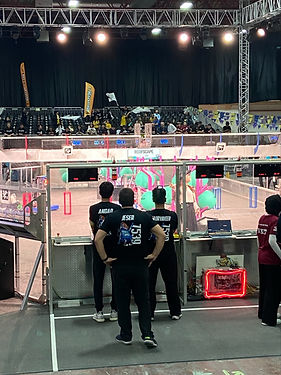
Since there are no FRC competitions in India, our team has traveled worldwide, participating in competitions in Houston, Istanbul, and New York. These experiences allowed us to collaborate, innovate, and form lasting memories while competing against top teams globally.
Journey of Scorpian
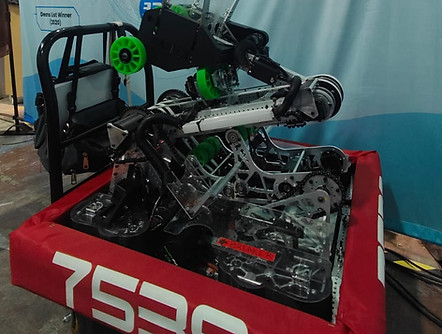
Scorpian, our 2025 robot, is the most complex project I have worked on. It was designed to pick up balls and tubes, place them at a drop-off station, and hang on a cage. Building Scorpian required months of prototyping, testing, and coordination between multiple subsystems. This project pushed me to apply advanced CAD skills, control systems knowledge, and real-time debugging under intense competition deadlines.
Advanced Swerve Drive
Scorpian featured our most advanced Swerve Drive, with independently controlled wheels, allowing movement in any direction and orientation. This provided the robot with exceptional maneuverability, enabling precise operations in tight spaces. We invested significant effort in tuning the drive code and PID loops, resulting in smoother turns, faster acceleration, and greater consistency during matches.

Vision and Automation
The robot incorporated the Limelight vision system for precise detection and alignment with field targets. This enabled automatic positioning at the scoring zone, improving both accuracy and cycle speed. Implementing this feature required custom vision pipelines and meticulous calibration under varied lighting conditions, enhancing our understanding of applied computer vision and reducing driver workload.
